In Confessions of a Union Buster, anti-union consultant Marty Levitt describes how anti-union consultancies and law firms often work hand in glove behind the scenes, serving as mutual referral sources.
“Rather than peddle their services directly to companies,” he wrote, his firm convinced attorneys to pitch their work “as a complement to the duties of labor lawyers,” allowing “attorneys and consultants [to] orchestrate a double-barreled attack on union drives … while staying out of reach” of reporting requirements for persuader activity.
Some consultants who engage directly with workers do report that activity, as required under the Labor-Management Reporting and Disclosure Act (LMRDA). Those disclosures make it possible to identify recurring partnerships between attorneys and anti-union consultants, and to track how they operate across organizing campaigns.
For example, Littler Mendelson attorney Jason Stanevich worked on anti-union campaigns at two employers – Vassar Brothers and Jewish Medical Center – that hired consultant Wildine Pierre of Bridge Labor Solutions last year. Meanwhile, attorney Robert Milman and consultant Jason Blain both worked on campaigns at two car dealerships, Destination Kia and Smithtown Kia, this year.
One clear recurring pairing is Littler Mendelson partner Brian Hentosz and consultants Daniel Block and Douglas Grima. They frequently work together through Legacy Consulting, headed by Luis Camarena and Eduardo Padilla. One campaign involving this pairing ultimately cost an Alabama manufacturer more than $290,000 – even though, as a consultant’s disclosure indicates, no known union was involved.
Public records paint a colorful picture of all four.
Hentosz is a partner attorney at Littler Mendelson, a firm that public records suggest charges between $550 and $1,760 per hour. Hentosz advertises “union avoidance” as one of his specialties. In addition to representing employers in 86 union election cases, he has defended employers in more than 80 unfair labor practice cases. In some of those cases, employers have entered into conformed settlement agreements to resolve charges including allegations of unlawful discharge, interrogation and coercive statements. (Such settlements typically indicate that the NLRB found merit to some of the allegations.)
Block, president of Labor Management Associates, has subcontracted for consultancies billing as much as $525 per hour per consultant. Court records and news reports indicate he has been charged with making “threatening and coercive statements to employees,” as well as telling “blatant lies” to workers about the cost of union dues.
Grima is a former president of a UAW local. He entered the union-busting business after the UAW had overturned the results of a local election he had won because it found the election’s integrity had been compromised.
Camarena, CEO of Legacy Consulting, was found by a judge to have shown a “willingness to resort to physical violence to protect his interests” and to have illegally threatened an employee. The judge also concluded in the case that Camarena “lacked credibility” and that he provided testimony that was “evasive, slippery” and “outright dishonest,” including his misleading claim he wasn’t hired to stop unionization, when he was.
Neptune Technology Group: A Case Study
An anti-union campaign at Neptune Technology Group, into which the company sank more than $290,000, offers insight into the sort of “double-barrelled attack,” as Levitt put it, that these four union-avoidance specialists can take part in. It also highlights how employers may invest thousands of dollars per worker to head off organizing before any union campaign has even materialized. Inconsistencies in the public disclosures surrounding the campaign also suggest there is more the public is entitled to know.
Neptune Technology Group, a manufacturer of smart water meters in Tallassee, Alabama, carried out the campaign between late September and October 2025, according to public and private records. Those records also suggest the effort may have begun months earlier and could still be ongoing. Legacy Consulting, Daniel Block’s Labor Management Associates, Douglas Grima and consultant David L. Craig all participated in the campaign. (Fun fact: Craig isn’t just a union-buster; he’s also a member of the city council in Hooper City, Utah.) Craig’s LM-20, filed in December 2025, reported that he conducted meetings from October 6 to October 16 with employees and developed training materials regarding workers’ rights under the National Labor Relations Act.
Part of what appears to have prompted Neptune’s response was a September 2025 report by Jobs to Move America documenting allegations of overwork, racial and gender discrimination, workplace injuries and broader systemic unfair treatment. On the same day the report was released, the coalition Good Neighbors Alabama sent a letter to the company asking that it begin discussions over a community benefits agreement (CBA) addressing issues including hiring, training, environmental practices and protections for workers “to speak freely among themselves and with representatives of non-profit and worker organizations without fear.”
On Sept. 29, Littler Mendelson attorney Brian Hentosz sent a letter to Jobs to Move America on behalf of Neptune. The letter stated that Neptune would not begin a conversation or enter into any agreement with Jobs to Move America.
About a week later, Craig arrived at the facility and began holding anti-union meetings, according to his LM-20. The company also circulated flyers falsely claiming that Good Neighbors and Jobs to Move America demanded the employer recognize a union, that workers start paying dues, and that the organizations had tried to trick workers into signing union authorization cards, Jobs to Move America told LaborLab.
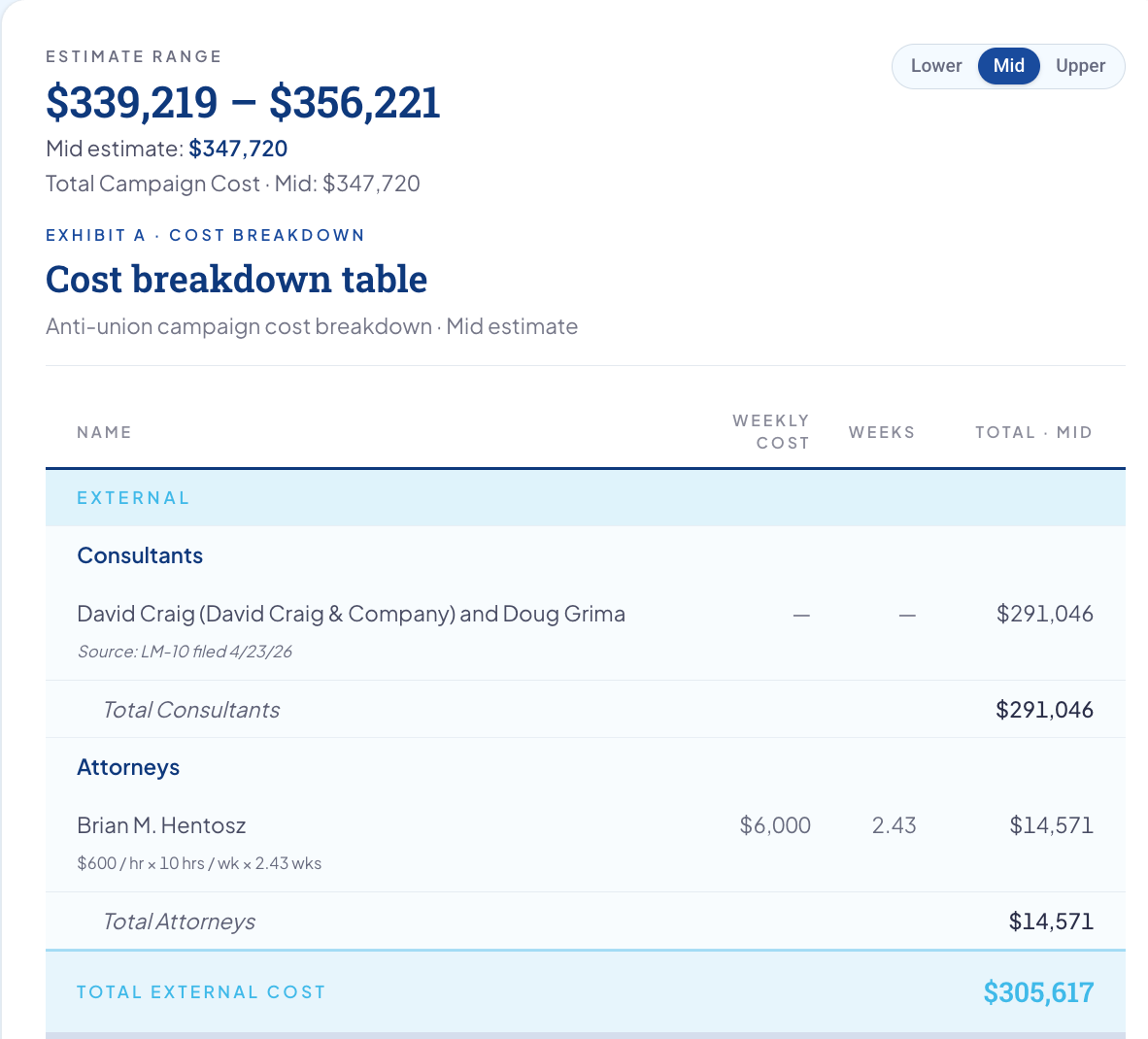
The extent of Neptune’s spending remained unknown until Jobs to Move America challenged the company’s failure to file its required LM-10 disclosure. After the organization submitted a complaint to the Office of Labor-Management Standards (OLMS), Neptune ultimately filed the report, revealing it had spent a whopping $291,046 on union-avoidance consultants. That same day, Camarena filed his own LM-20 – 311 days after entering into the agreement with Neptune and well beyond the 30-day reporting deadline.
While Craig had listed Camarena as principal consultant of Legacy Management Advisors, Camarena identified himself in his LM-20 with a seemingly different, but related, company, Legacy Consulting. Furthermore, Camerana’s LM-20 indicated that Legacy Consulting had subcontracted union-busting services not only to Craig, but also to Doug Grima, another consultant who has repeatedly worked on cases involving Hentosz.
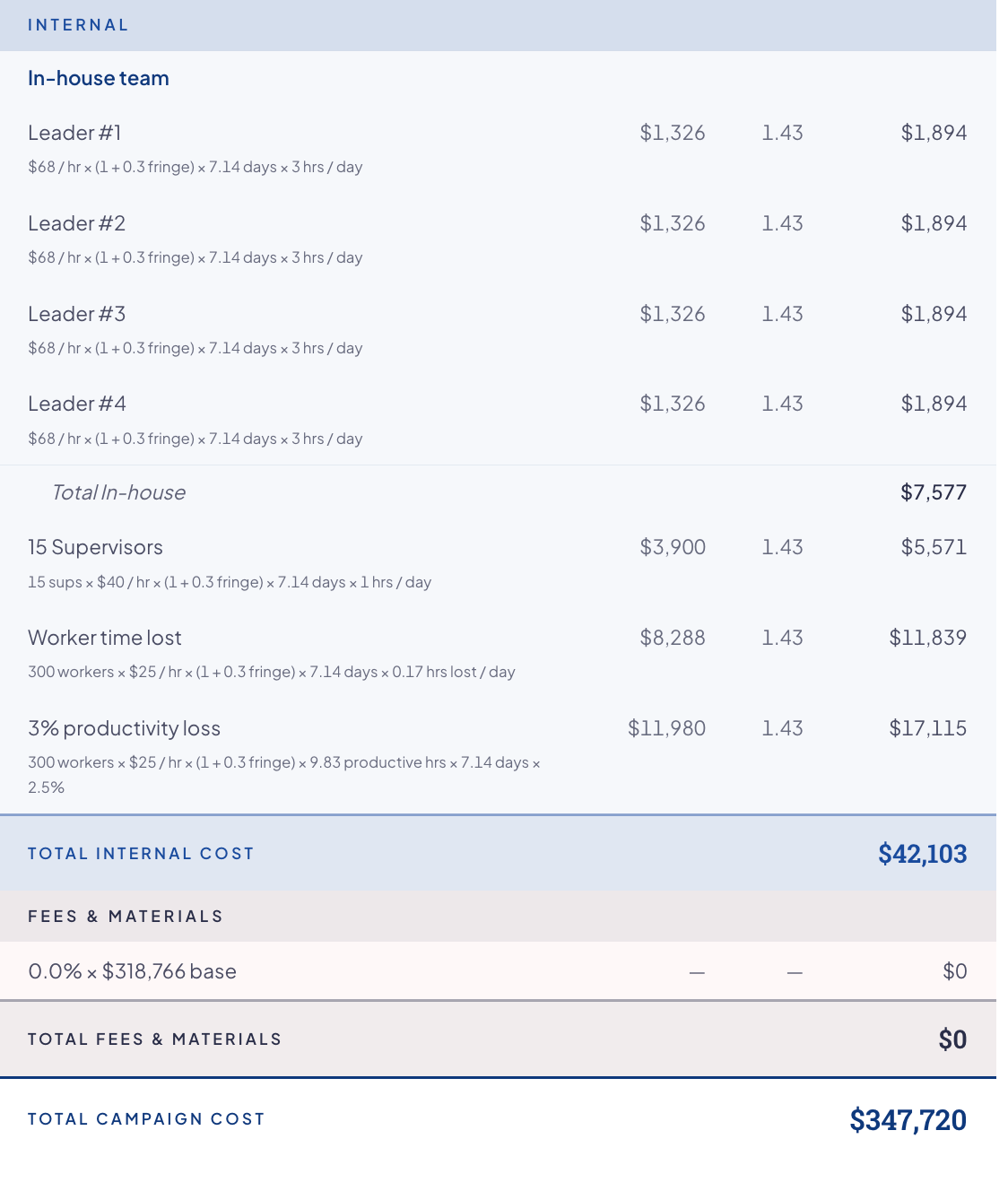
In Tallassee, Neptune employed roughly 300 workers in 2024, according to an Alabama environmental inspection report. If it employed the same number of workers during the anti-union campaign, Neptune would have spent about $1,000 per worker on persuader activity alone. That figure excludes payments to Hentosz, employee and supervisor time devoted to campaign meetings, and lost productivity. When those other costs are taken into account – using a methodology developed for a report to the Minnesota Senate and information provided by Jobs to Move America – LaborLab estimates the anti-union campaign’s total cost at between $339,000 and $356,000. LaborLab’s mid-estimate is $347,720, equivalent to nearly $1,200 per worker.
This could be frustrating to workers who would appreciate a pay increase.
For a summary of our estimate, see below. (We’ve also included a full cost breakdown at the end of this post.)

But the disclosures leave important questions unanswered.
Camarena’s LM-20 states that Legacy Consulting actually entered into its agreement with Neptune on June 16, 2025 – nearly four months before Craig reported meeting with workers. This raises the possibility that Legacy provided additional consulting services before any reportable persuader activity began and that those services are not reflected in the $291,046 that Neptune disclosed spending.
The filings also conflict in other ways. Craig reported that his work began on Oct. 6 and ended Oct. 16. Camarena’s filing states that work by Craig and Grima began Oct. 26 and was still ongoing months later. Daniel Block – whose address Craig listed on his LM-20 as the location where records necessary to verify the report are kept – and Douglas Grima have yet to file LM-20 disclosures. And although Neptune acknowledged the existence of a written agreement with Legacy Consulting, it did not attach the agreement to its LM-10 as required under the LMRDA. That’s despite the fact that the box that Neptune filled out to indicate that the agreement exists states, “Written agreement entered into the fiscal year must be attached.”
Beyond Neptune
The Neptune campaign was not an isolated case. Cross-matching LM-20 disclosures with NLRB representation cases reveals that Hentosz, Block and Grima have repeatedly worked on the same anti-union campaigns over the last two years. The cases below represent the instances we could identify through public records.
Covestro (Hebron, Ohio): Alongside Littler Mendelson colleague Morgan Dull, Hentosz represented Covestro as it faced an organizing drive in Hebron, Ohio. The company entered into an agreement with Legacy Consulting more than two weeks before workers filed an election petition on March 17, 2026, suggesting it became aware of the organizing well before it became public. Legacy immediately launched what it described as a “Card Mitigation / Union Awareness” campaign, with Block and Grima serving as subcontractors. Grima reported that his work ended on May 1. Between May 7 and May 8, one unit of workers voted to affiliate with IUOE Local 18, while another voted against representation by IBT Local 637.
Gold Star Foods (Huntingdon, Pennsylvania): The previous month, Hentosz was working alongside Legacy Consulting, Block and Grima on another anti-union campaign, again with Littler colleague Dull. Workers petitioned for an election on Dec. 31, 2025, but Block reported beginning work as early as Aug. 5 – nearly five months before the petition was filed. Grima joined the campaign Jan. 13 and concluded his assignment two days before the election, while Block continued providing services for at least two days afterward.
PPG: Public records also suggest Hentosz and Block may have worked on organizing campaigns involving PPG facilities. Block reported beginning a “Card Mitigation / Union Awareness” campaign at a Huntsville, Alabama facility two days after an election at PPG’s Strongsville, Ohio, facility, where Hentosz served as attorney of record alongside Littler colleagues Jason Hartzell and Monica Sislak. Hentosz has also represented PPG facilities in Joliet and Chicago. Available records do not conclusively establish that the two participated in the same campaign. Their history of working together, however, suggests it is a distinct possibility.
Westinghouse Electric Company: Hentosz represented Westinghouse Electric in early 2024 while at Holland & Knight during one of the most aggressive anti-union campaigns LaborLab has documented in recent years. Once again, Block, Grima and Legacy Consulting were on the ground. Block reported beginning work days after IBEW petitioned for an election. During the campaign, the union accused Westinghouse of numerous unfair labor practices, including coercive conduct, unlawful rules, and unlawful statements. Hentosz defended the company against those charges. One consultant Block subcontracted, Wildine Pierre Barrett, was herself accused of committing an unfair labor practice. LaborLab later filed a special complaint with the OLMS alleging multiple apparent LMRDA reporting violations related to Westinghouse’s anti-union campaign. Westinghouse has yet to file its required LM-10 disclosing its total spending on consultants.
Graves Menumaker Foods Transportation: Hentosz also represented Graves Menumaker Foods Transportation during a campaign involving Block and Grima. The employer ultimately reported spending $126,802 on persuader activity – roughly $9,057 for each of the 14 would-be eligible voters – before IBT Local 886 withdrew its election petition. That figure does not include attorney fees paid to Hentosz.
Neptune also illustrates the limits of this analysis. The cases above are only the campaigns that become visible when organizing culminates in an NLRB representation case and consultants report engaging in persuader activity. Campaigns that end before a petition is filed, or that rely entirely on behind-the-scenes consulting, may leave little or no public record. As a result, there may be additional campaigns in which Hentosz, Block and Grima worked together that cannot be identified through existing disclosures alone.
Who Refers Whom?
The frequency with which some attorneys and non-attorney consultants work in tandem raises another question: Who refers whom?
The available evidence suggests attorneys often play that role.
Cross-matched LM-20 disclosures and NLRB representation cases indicate that employers typically retain labor counsel before hiring non-attorney consultants. Some LM-20 disclosures also identify attorneys as the intermediaries through which employers retain consultants. For example, one LM-20 we found states that the company Drywall Supply entered into its agreement with anti-union consultancy RoadWarrior Productions through Littler Mendelson attorney Alice Kirkland.
Accounts of organizing campaigns likewise describe management-side attorneys participating in decisions to retain consultants. During organizing at Cemex, for example, a Jackson Lewis attorney sat on the steering committee that decided to hire non-attorney consultants. Those consultants, overseen by LRI Consulting, went on to commit a wide range of unfair labor practices during meetings with workers, according to court findings. According to an NLRB decision, LRI was ultimately paid $1.136 million – equivalent to roughly $3,079 per eligible voter ($1.136 million / 369 unit members).